
Discovering Mojo
A Supercharged Python Superset for Optimal Performance


Welcome to the thrilling world of Mojo, a revolutionary programming language that is a supercharged superset of Python. Designed to optimise performance while maintaining Python's elegant simplicity, Mojo is enhancing how we interact with machine code, providing a seamless blend of power, efficiency and usability. This article will guide you through Mojo's unique features, demonstrating how it amplifies Python's capabilities while ironing out some of its limitations.
Embarking on the Mojo Journey: An Overview
Mojo is a statically-typed language that, while extending Python, revolutionises our concept of compile-time meta-programming. Its advanced features, built directly into the compiler, function as a separate stage of compilation. These stages execute after parsing, semantic analysis, and intermediate representation (IR) generation, but precede lowering to target-specific code.
A fascinating aspect of Mojo's design philosophy is the notion of using the host language for both runtime programs and meta-programs. This principle, coupled with the utilisation of MLIR (Multi-Level Intermediate Representation) for representing and evaluating these programs, leads to a highly predictable programming environment. By harnessing MLIR, Mojo is able to achieve efficient translation and transformation between various forms of abstraction. Let's delve deeper into some of the unique attributes of Mojo.
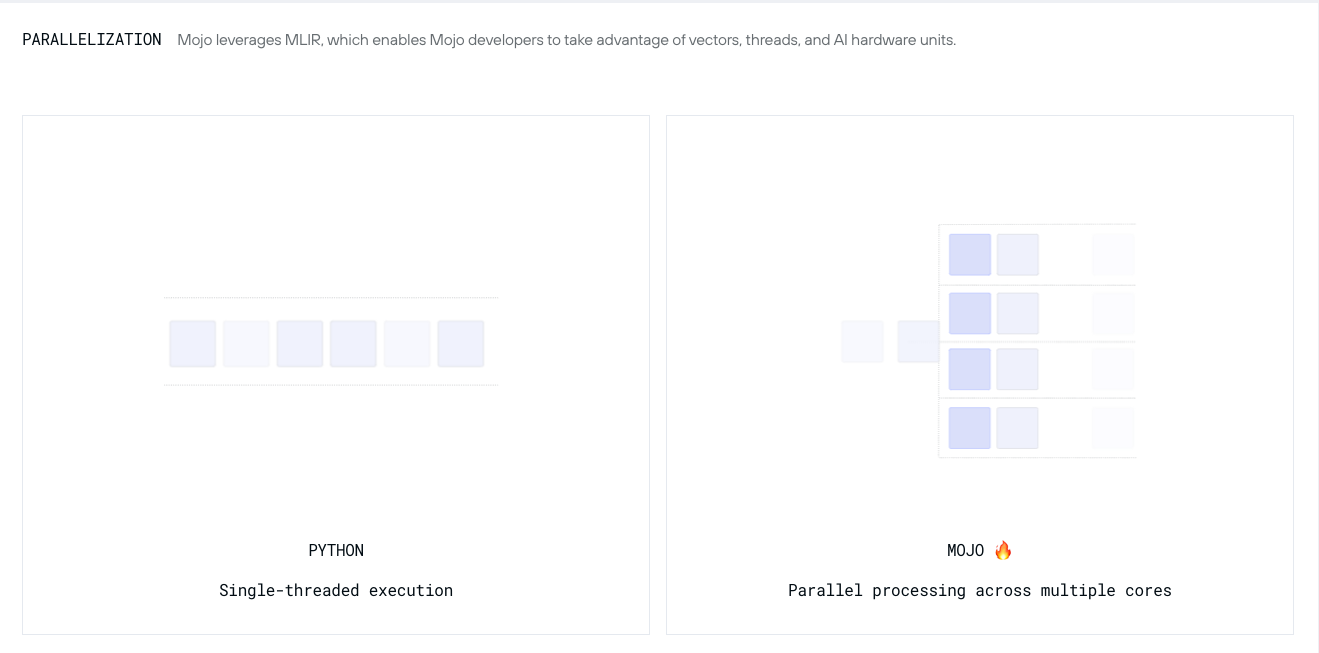
Mojo's Unique Approach to Parameters and Aliases
In Mojo, parameters are declared in square brackets, adhering to an extended version of Python's PEP695 syntax. These parameters are more than mere placeholders—they are named and typed just like standard values within a Mojo program. The fascinating twist is that they are evaluated at compile time rather than runtime, lending a new level of flexibility and efficiency to your code.
One of Mojo's distinctive features is its approach to aliases. Aliases in Mojo can refer to parametric values but are not themselves parameterised. While this concept might seem counterintuitive, it is a part of Mojo's philosophy to optimise performance. This approach can be illustrated with the following example:
alias Scalar[dt: DType] = SIMD[dt, 1]
alias mul2[x: Int] = x * 2
error: Expression [2]:5:1: declaration must have either a type or an initializer alias Scalar[dt: DType] = SIMD[dt, 1] ^ error: Expression [2]:6:1: declaration must have either a type or an initializer alias mul2[x: Int] = x * 2 ^
Contrary to what one might expect, the code snippet above does not function as intended. The Mojo compiler provides detailed error messages in such situations, highlighting the areas where the code falls short of the language's expectations.
Benchmarking Mojo Implementation and Performance Gains
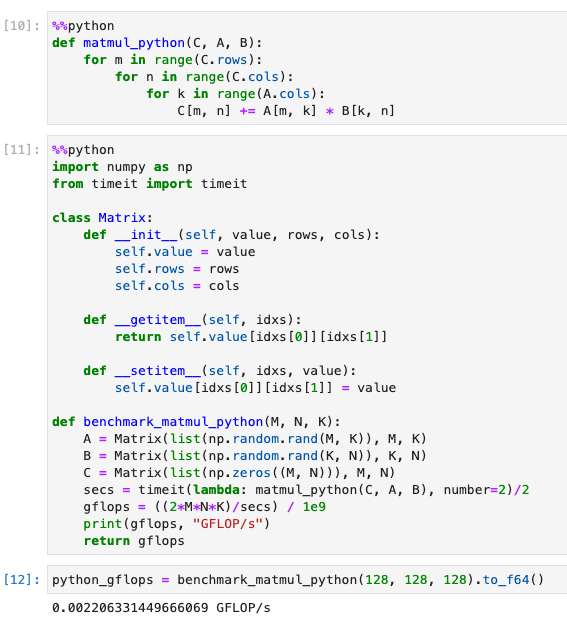
In order to assess Mojo's computational prowess, a benchmark test was conducted comparing matrix multiplication performance in both Mojo and Python. Below is a succinct summary (Notebooks provided by Modular):
Python Implementation:
Mojo implementation:
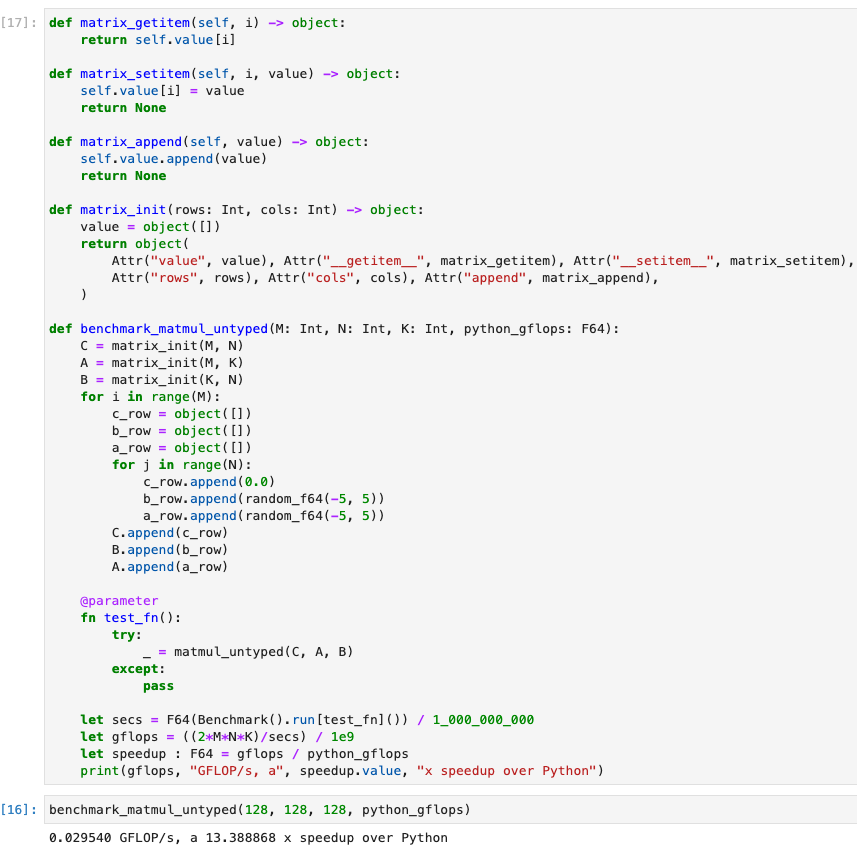
Results:
A notable 0.029540 GFLOP/s, equating to a 13.388868-fold speed increase over Python
The Mojo approach notably outperformed Python, underlining Mojo's impressive efficiency and optimisation in tackling matrix computations.
The marked performance enhancements seen upon shifting to Mojo underline its stature as a superior programming language for high-performance tasks. Mojo effortlessly boosts code performance, all the while retaining Python's hallmark simplicity and elegance.
Handling Errors and Exceptions in Mojo
In Mojo, the terminology for exceptions has been reimagined. Instead of the traditional "Exception" used in Python, Mojo introduces the term "Error". This might initially surprise Python developers, but the reasons behind this nomenclature shift are logical and compelling.
fn raise_an_error() raises: raise Error("I'm an error!")In the example above, the function raise_an_error() raises an "Error". This is significant because, unlike in Python, raising an error in Mojo does not cause stack unwinding. More importantly, it does not generate a stack trace. In the absence of polymorphism, the "Error" type is the only kind of error that can be raised in Mojo at present.
Embracing Asynchronous Functions and Rebinding in Mojo
Asynchronous programming has become a cornerstone of modern software development, particularly in the realm of web development and high-performance computing. While Mojo supports asynchronous functions using async fn and async def, it currently lacks support for Python-style generator functions (yield syntax) and the async for and async with statements.
Mojo also brings a new feature to the table: the "rebind" built-in function. In situations where Mojo cannot determine whether some parametric types are equal, which can occur due to not performing function instantiation in the parser as in C++, it may complain about an invalid conversion. This usually happens in static dispatch patterns. In such a scenario, the "rebind" function can be used to manually "rebind" the type of a variable.
from TypeUtilities import rebind
fn generic_simd[nelts: Int](x: SIMD[DType.f32, nelts]):
    @parameter
    if nelts == 8:
        take_simd8(rebind[SIMD[DType.f32, 8]](x))
In the above code snippet, the function generic_simd takes a SIMD value of a specific type and size as an argument. If the size matches the desired value, it calls the take_simd8 function, rebinding the type of the input variable to ensure type compatibility. This nuanced control over type handling is one of the many ways Mojo elevates your control over your code's performance.
Navigating Scoping and Mutability in Mojo
In Mojo, the scoping and mutability rules exhibit slight deviations from their Python counterparts. Local variables are implicitly declared and scoped at the function level, but this feature is supported in Mojo only inside def functions. There are also nuances to Python’s implicit declaration rules that Mojo does not match one-to-one.
For instance, the scope of for loop iteration variables and caught exceptions in except statements is limited to the next indentation block for both def and fn functions. This difference in scoping rules can initially be challenging to Python developers transitioning to Mojo, but it is a crucial part of Mojo's strategy to enhance runtime efficiency.
for i in range(3): pass
print(i) // Mojo will complain here: 'i' is not defined at this point.
In the above code, Mojo will raise an error at the print(i) statement because i is not defined in that scope, unlike in Python where i would retain its last value from the loop.
Furthermore, in Mojo's def functions, the function arguments are mutable and re-assignable, whereas in fn, function arguments are r-values and cannot be re-assigned. This rule extends to statement variables, such as for loop iteration variables or caught exceptions:
def foo():
    try:
        bad_function():
    except e:
        e = Error() // ok: we can overwrite 'e'

fn bar():
    try:
        bad_function():
    except e:
        e = Error() // error: 'e' is not mutable
Delving into Nested Functions and Alias Declarations
In Mojo, nested function declarations are static, which means calls to them are direct unless specified otherwise. This means you currently cannot declare two nested functions with the same name, a scenario that is feasible in Python. The functions in each conditional must be explicitly materialised as dynamic values.
Another intriguing characteristic of Mojo is that alias declarations are non-lexical, meaning they can be referenced before they are defined. This applies to both forward alias declarations and alias initialiser declarations. This design choice is quite intentional and allows powerful code constructs.
fn use_before_def():
    alias y = x
    alias x = 10
    return y
In the above code, alias y refers to x before x is defined. This form of forward referencing can be particularly useful in certain code patterns.
Understanding Module Imports in Mojo
One of the current limitations of Mojo is that it doesn't support module imports in the traditional Python sense. For example, you can't simply import a whole module like import Vector. Instead , Mojo encourages direct imports from other modules. This approach can initially seem a bit more verbose, but it ensures greater clarity in the code base by explicitly specifying which entities are being imported.
from String import String
from Vector import DynamicVector as DVector
In the code above, we explicitly import String from the String module and DynamicVector from the Vector module, renaming it to DVector for use in our code. This explicitness can significantly reduce ambiguity and potential namespace conflicts in larger code bases.
Wrapping Up: The Future of Mojo
The world of Mojo offers a remarkable blend of Python's elegance and the raw power of statically typed languages. By introducing features like compile-time parameters, rebind functionality, and a unique approach to scoping and mutability, Mojo manages to strike a delicate balance between user-friendly syntax and high-performance computing.
However, like any young language, Mojo is still evolving. The language designers have ambitious plans for its development, including addressing the lack of support for Python-style generator functions and the 'async for' and 'async with' statements. Additionally, efforts are underway to refine the handling of nested function naming and to support module imports in a more Pythonic way.
Capitalising on Python's virtues and addressing its drawbacks, Mojo stands poised to leave a lasting imprint on the landscape of high-performance computing. The trajectory of its growth, coupled with the ingenious applications its users are likely to craft, promises an exciting spectacle.
In conclusion, Mojo is not just a new language; it's a daring reinvention of the Python paradigm, supercharged for optimal performance. With its innovative features and a clear roadmap for future enhancements, it's a language worth exploring for any developer looking to push the boundaries of what's possible with Python. Embark on the Mojo journey today and experience the future of high-performance Pythonic programming.
To experience Mojo firsthand, visit the website and register. Make sure to select the Mojo option in the "Modular Product Interest" section during the registration process.